
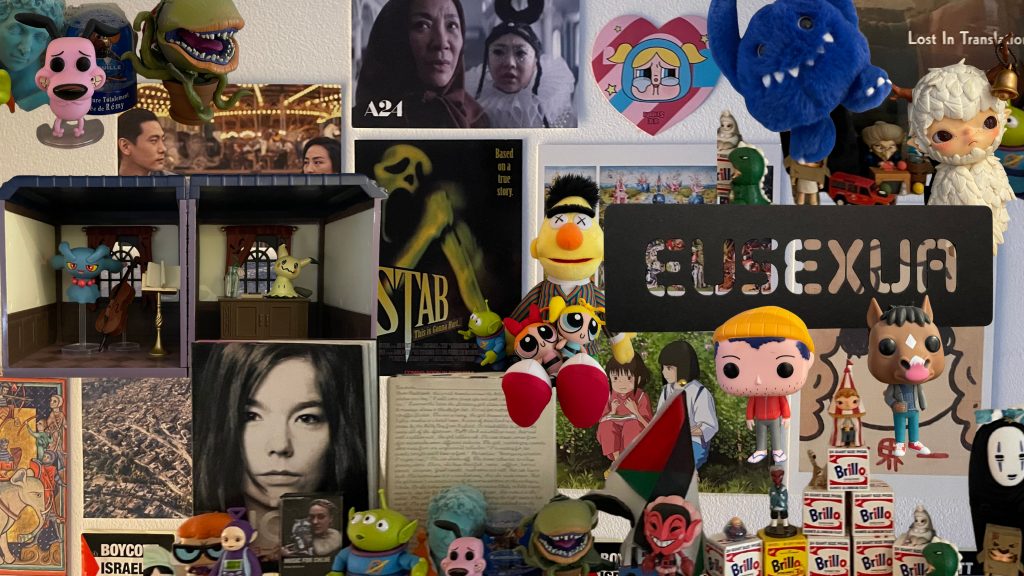
Above you can see a collage of the many objects I’ve collected over the years to decorate my home. The more items I add, the more at home I feel. It is important to acknowledge that I only allow items that emit joy and that I feel are a representation of me. It has been clear through my process so far that there is a big emphasis on our relationship with objects. In an expert stakeholder meeting with meme admin @DalstonSuperStoned, they mentioned that the objects (charms, accessories) they keep on their person are artifacts that represent both them and their online persona. This got me thinking about my own personal relationship with objects and how certain items feel inherently like me. Behaving almost as small extensions of my identity, almost like a visual shorthand for who I am.
The premise of my research and findings so far has defined that memes behave as cultural artefact that carry shared meaning within communities and subcultures. Memes behave like objects that are passed between people, acquiring meaning through repetition. Ibrahim (2002), author of Digital Icons: memes, martyrs and avatars, says that “Memes manifesting in cultural settings through objects, behaviours and belief systems, such as clothing, vernacular terms, rumours or even abstract beliefs, spread from person to person through emulation or repetition” (pages 8-9). Just like how the project unintentionally started with an intervention of creating a meme shirt and has evolved to become an exploration of how post-millennial meme culture transforms everyday things into opportunities to establish a shared connection.
There seems to be a feedback loop between identity and media, and how media can shape how we engage with things. “Your identity shapes your media, and your media then shapes what you believe and what you care about” (Pariser, E. 2011, page 125). My obsession with meaningful items is part of this loop. My taste and humor, and the way I see things shape what memes I relate to and how those memes influence what items feel like me. At the end of the day, as John Berger (2008) says, “We never look at just one thing; we are always looking at the relation between things and ourselves” (page 29). The item ultimately becomes a mirror of belonging, tied to what it means to me and my community.
Objects and memes overlap as personal and collective identity markers. That is why the notion of Offline Artefacts is very relevant to my project, as they behave as symbols of shared culture, humor, and individuality. The obsessions with items aren’t just about possession but rather participation; part of a visual and emotional dialogue that exists online and offline. These objects and things seem light, almost disposable, yet they hold a weight of who we are. Many objects, scattered both on our screens, on our bodies, and in our homes, so light yet so heavy with meaning.

References:
Berger, J. (2008) Ways of seeing. London : Penguin
Ibrahim, Y. (2022) Digital icons : memes, martyrs and avatars. London : Routledge
Pariser, Eli. (2011) The filter bubble: what the internet is hiding from you. London : Viking