In my previous intervention, I asked people to share meme-related items in their homes. The purpose was to explore people’s relationship with items and objects. My path so far has been studying memes as isolated cultural artefacts; however, I now need to move toward understanding the social glue they create. That sense of shared recognition and humor that bonds people in the community through absurd meme-related objects. While not all responses from the last intervention were directly related to the meme, they revealed and solidified that people attach humor and affection to personal objects. The shift in focus for this new intervention is an evolution rather than a new direction. I realised, based on the responses received, that I need to more deeply explore the shared sense of belonging that emerges through humorous associations.
The current approach for this iteration is not too different from the last intervention, but rather an evolved version of it that asks participants to directly reference the shared sense of belonging. Ultimately, the vagueness of the last intervention is what helped me hone in on the intention for this iteration. The intervention is to ask participants to share images and stories of objects and locations that they and their friends find unintentionally funny. The aim is to understand how shared humor can transform ordinary things into social symbols.
The image below is the Instagram story that I used. The lo-fi method aligns with the casual nature of participation and the informality of meme culture.
I recieved a total of 4 direct responses, plus likes and reactions to the story, which I interpreted as passive participation, as it seems some people acknowledged the notion and might not have an example at hand. At some point, I wondered if some might have thought it was a meme… While some people only interact with likes, this can be seen as a form of silent participation (akin to how meme engagement occurs online).
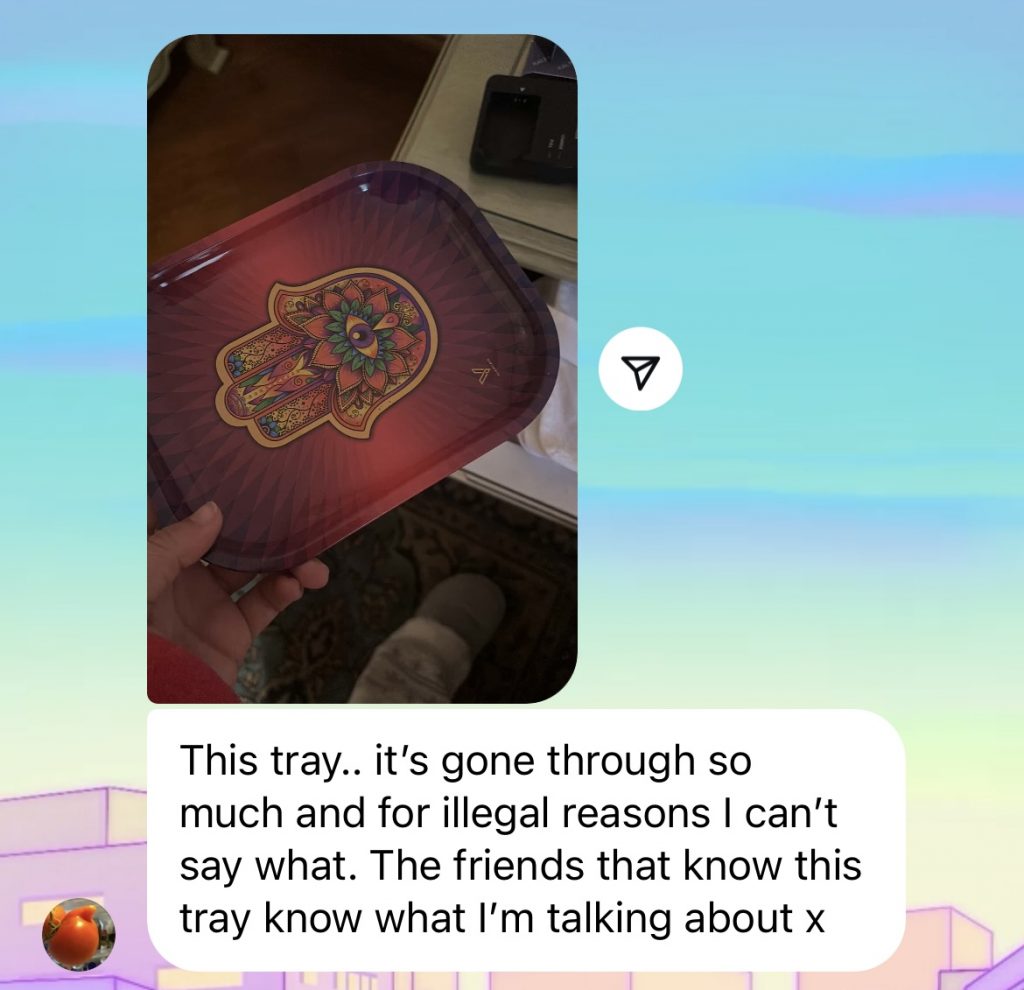
The following answer I’ve recieved [see below] acts as a multi-layered artefact, connecting pop culture, friendship, and even the participant’s personal memories. It goes on to highlight the intersection of shared digital references and emotional resonance. It goes back to the constant notion I have been exploring of how humor operates as a form of recognition.
The most important insight by far that I recieved from the responses is receiving the same object from two different participants.
__
Both of these mutual friends’ input on the same object was quite insightful. Both responses spoke about the column in the same sense of affection and humor. Almost as if the architectural feature had taken on a life of its own. As you can see in the first image, the participant wrote a playful poem about it (continuing to feed into a brain-rot approach). The pillar has taken on a life and a meaning of its own, becoming a sem-meme-iotics of its own right. A column that has a meaning only within a micro-culture that exists of a handful of people. This shared joke about the column mirrors how meme culture operates. Memes gain meaning through repetition and collective recognition. This reflects the core of my research question: how post-millennial meme culture can turn everyday spaces and objects into opportunities for belonging. The process by which inside jokes form around mundane, everyday objects operates in the same way as digital memes. Ultimately, relying on participation, shared context, and the notion of being “in on the joke.”
In the previous intervention, I focused on the relationship between memes and objects, while in this one, the focus shifted to people and their shared experiences. This brought the realisation that the feelings of belonging and humour can’t be forced or universalised, which aligns with my previous research on Erin Meyer’s notion of high-context culture theory and Saussure and Barthes’ semiotics. While there was not much quantitative data from this intervention, the unexpected overlap in receiving the same item demonstrated the kind of collective recognition that mirrors how memes function.
Based on what I learned from this intervention, my next step will be to continue exploring how shared moments of humor evolve into symbols of belonging. The responses from this exercise highlighted that meaning can emerge through collective recognition and knowledge. Moving forward, I would like to create a way to observe, test, and document these shared interpretations in a more tangible way.
Other contributions: